For years, I told families to think twice before opening a 529 plan. There was no federal tax deduction, investment choices were limited, and unused money could trigger taxes and penalties when withdrawn. Then SECURE 2.0 changed the equation: up to $35,000 of leftover 529 money can now be rolled into the beneficiary’s Roth IRA. That turns a college-savings account into a potential retirement head start.
A 529 plan can still pay for qualified education expenses tax-free. But it no longer has to be an all-or-nothing college fund.
If your child does not need every dollar for school—or if you cover college costs from other savings—you may be able to move up to $35,000 from the 529 into a Roth IRA in the child’s name. The rollover is tax-free and penalty-free when it meets federal requirements.
Why the Roth Matters
A Roth IRA is one of the most powerful long-term accounts available because qualified withdrawals in retirement are generally tax-free. Money moved there early has decades to compound without creating a future tax bill on qualified distributions.
Consider a simple illustration: if $35,000 is rolled into a child’s Roth IRA by age 30 and then grows at 10% annually until age 65, it could reach roughly $1.3 million—without the child contributing another dollar. That is not a guarantee of future returns, but it illustrates why time in the market and tax-free compounding matter.
Hypothetical illustration: $35,000 rolled into a Roth IRA over ages 25–29 ($7,500 a year for four years, then $5,000), earning a constant 10% a year to age 65. Not a guarantee of future returns.
The Five Rules
The strategy is straightforward, but every condition must be met.
| Rule | What it means |
|---|---|
| 115-year Account Age | The 529 must have been maintained for at least 15 years before the rollover. Opening the account early starts the clock. |
| 2$35,000 Lifetime Cap | The limit is per beneficiary, not per year. Two children can each have their own $35,000 rollover capacity. |
| 3Annual Limit | The rollover counts toward the beneficiary’s annual Roth IRA contribution limit—$7,500 for 2026 for those under 50. Moving the full $35,000 therefore takes about five years. |
| 4Five-year Trap | Contributions made in the previous five years, plus earnings on those contributions, cannot be rolled over. |
| 5Earned Income | The child must have at least as much earned income as the amount rolled over in that year. A part-time job, summer work, or legitimate self-employment income can qualify. |
The 15-year Rule Starts on Day One
To roll 529 money into the beneficiary’s Roth IRA, the 529 account must have been maintained for at least 15 years before the rollover. That means the clock starts when you open the account—not when your child starts college or when you decide to use the strategy.
A family that opens a 529 when a child is 10 can generally begin rollovers when the child is 25. But a family that waits until the child is 18 to open the account cannot use the strategy until the child is 33, even if the account has a large balance and the child has earned income.
This is why opening a 529 early matters, even if the initial contribution is modest. The account’s age is a prerequisite for the Roth rollover; the balance can be built over time.
$35,000 Lifetime Cap
You can roll a maximum of $35,000 per beneficiary from a 529 plan into that beneficiary’s Roth IRA over their lifetime. The limit is not annual, so you cannot move $35,000 in a single year; instead, rollovers are constrained by the annual IRA contribution limit and must be completed over multiple years. For 2026, that limit is $7,500 for a beneficiary under age 50.
Suppose a family has $35,000 available in an eligible 529 when the child turns 25:
| Year | Rollover | Running total |
|---|---|---|
| Year 1 | Roll $7,500 | $7,500 |
| Year 2 | Roll $7,500 | $15,000 |
| Year 3 | Roll $7,500 | $22,500 |
| Year 4 | Roll $7,500 | $30,000 |
| Year 5 | Roll $5,000 | $35,000 |
Assumes the 2026 limit of $7,500 applies each year and the child has at least that much earned income. Future limits may be higher.
If the child also makes their own Roth contribution in a given year, that contribution shares the same annual limit. For example, if your child earns $10,000 and contributes $2,500 of their own money to their Roth IRA, only $5,000 remains available that year for the 529-to-Roth rollover.
The Five-Year Trap: Don’t Wait Too Long
The five-year rule is easy to overlook. Contributions made during the five years before a Roth rollover—and the earnings on those contributions—cannot be moved into the Roth IRA.
Imagine parents contribute $10,000 to their child’s 529 when the child is 17. When the child turns 22, the parents want to begin Roth rollovers. They cannot roll over that $10,000 contribution—or its earnings—because it was made within the preceding five years.
If they wait until the child is 23, the contribution has aged beyond the five-year window and becomes eligible, assuming all other requirements are met. This is another reason to avoid making large last-minute 529 contributions if a Roth rollover is part of the plan.
Why Earned Income Matters
A child does not need a high-paying job to participate, but they do need legitimate earned income to contribute to their Roth IRA.
At 22, Sofia works part-time at a coffee shop and earns $9,000 during the year. Her parents can roll up to $7,500 from her eligible 529 into her Roth IRA because her earned income exceeds the rollover amount.
By contrast, if Sofia is a full-time student with no wages or self-employment income, she cannot receive a 529-to-Roth rollover that year—even if the 529 has been open for 15 years and has plenty of money available. The earned-income requirement is not optional.
This is why families should think ahead: a teenager with a summer job, a child working in a family business, or a young adult with a part-time job may create the earned income needed to begin the rollover sequence.
Plan the Timeline, Not Just the Balance
The most effective 529-to-Roth strategy is built around timing:
- Open a separate 529 for each child as early as possible to start the 15-year clock.
- Avoid large contributions in the final five years before the rollover period if preserving Roth eligibility is a priority.
- Confirm that the child has enough earned income before attempting a rollover.
- Use a direct trustee-to-trustee transfer from the 529 custodian to the child’s Roth IRA; do not withdraw the funds personally.
The families that benefit most are not necessarily those with the largest 529 balances. They are the ones that opened the account early, spaced contributions appropriately, and understood the timing rules before the money was needed.
Example: The Early Starter
Meet Maya. Her parents open a 529 when she is 10 and contribute steadily over the next eight years. At 18, Maya receives a scholarship and uses her parents’ separate savings for college instead.
Because the 529 has been open for more than 15 years by the time Maya is 25, her parents can begin rolling money into a Roth IRA in Maya’s name. They move $7,500 per year for four years, then $5,000 in the fifth year, using the full $35,000 lifetime rollover allowance.
At age 30, Maya has $35,000 in a Roth IRA. If that money remains invested and earns an assumed 8% annually, it could grow to approximately $517,000 by age 65.
The lesson is simple: the account’s age matters as much as its balance. Opening a 529 early preserves flexibility, even if your child earns a scholarship, attends a less expensive school, or decides not to attend college.
Example: College and a Roth
Now consider Ethan. His parents save $80,000 in a 529 beginning when he is 8. He attends a state university, and the 529 covers $45,000 of qualified education costs.
That leaves $35,000. Because the account has been open for at least 15 years, Ethan’s parents can roll that remaining balance into his Roth IRA over several years, subject to the annual limit and Ethan’s earned income.
Ethan gets both outcomes: tax-advantaged help with college and a $35,000 retirement head start. The 529 no longer forces parents to choose between saving too much for college and leaving money stranded in an education account.
Two Execution Mistakes to Avoid
First, do not withdraw the money yourself and redeposit it. The transfer must be a direct trustee-to-trustee rollover from the 529 custodian to the Roth IRA custodian; taking the cash out first can create a nonqualified distribution problem.
Second, the Roth IRA must belong to the 529 beneficiary—not the parent or grandparent. This strategy builds retirement savings for your child or grandchild, not for you.
Current Drawbacks
The Roth rollover fixes the biggest weakness of the 529, but it does not make the account perfect.
- There is still no federal income-tax deduction for contributions, although some states offer a state-level deduction or credit.
- Investment menus are limited to the plan’s approved options; you cannot self-direct into individual stocks, real estate, private funds, or crypto while the money remains in the 529.
- Money above the $35,000 rollover limit may still face tax and a 10% penalty if withdrawn for nonqualified purposes.
Size the 529 With Both Goals in Mind
When funding a 529, consider both the education costs you expect to cover and the $35,000 Roth rollover opportunity you may want to preserve. For example, a family expecting to use $60,000 from savings and cash flow for college might target roughly $95,000 in the 529, adjusted for expected investment growth, financial aid, scholarships, and the timing of college expenses.
That target will not be right for every family. The key is to size the account intentionally: enough to support education goals, while leaving room to preserve the Roth rollover opportunity. Unused 529 assets can also be moved to another eligible family member’s 529, adding flexibility for families with more than one child.
The Bottom Line
A 529 is no longer merely a college fund. Used well, it can pay for education and leave behind a tax-advantaged retirement foundation for the next generation.
If you have children or grandchildren, start the 529 clock now, plan for the annual rollover limits, and make sure they have earned income when the transfers begin. The families that benefit most will be the ones that planned years before the first tuition bill arrived.
The 15-year clock begins the day you open the account.
Keep contributing, and avoid big deposits in the last five years.
15 years open, earned income, and no contributions (or their earnings) from the prior 5 years.
Direct trustee-to-trustee transfers, within the annual limit.
Let the Roth grow for retirement, with tax-free qualified withdrawals.
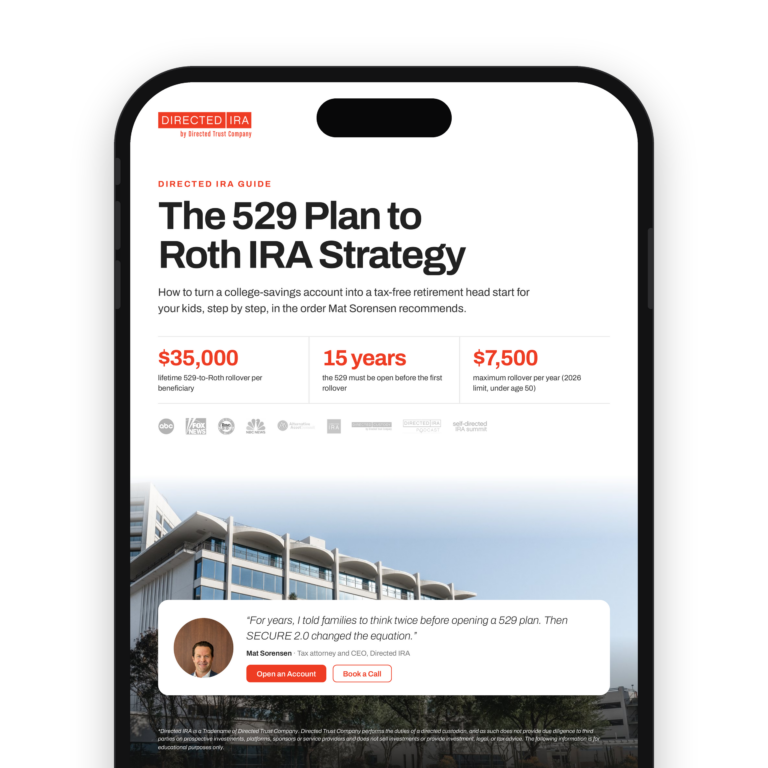
Download the guide and learn how a 529 (along with other kid accounts) can be rolled into a Roth IRA, step by step, in the order Mat Sorensen recommends.
Download the Free GuideOr book a free 15-minute callDisclosure: This article is for educational purposes only and does not constitute investment, legal, or tax advice. Directed Trust Company performs the duties of a directed custodian and does not provide due diligence on prospective investments, sponsors, or service providers and does not sell investments or provide investment, legal, or tax advice. Hypothetical examples assume a constant rate of return and are not a guarantee of future results. Consult your tax, legal, and financial advisors about your specific circumstances.