Mat Sorensen:
Welcome to the Directed IRA Podcast. I’m Mat Sorensen, and I’m here with the incredible Mark J. Kohler. Today we’re talking about how you can use an IRA to invest in a rental property, a house flip, or even private lending.
If you haven’t heard of this before, it’s called a self-directed IRA. It’s a very popular strategy, and it’s something both Mark and I have used ourselves.
Mark J. Kohler:
If you’re a regular listener, this is a great episode to share with a friend, family member, or business partner who keeps hearing you talk about self-directed investing but still doesn’t quite get it.
We’re going to keep this simple. We’ll walk through real examples, explain the main options, and cover the basic steps so you leave with a solid overview of how this works.
Real Estate in an IRA Means Real Property, Not Just REITs
Mat Sorensen:
We’re opening hundreds of new accounts every month, and a lot of people are just learning what’s possible with retirement accounts. So let’s start with the basics.
When we talk about buying real estate with an IRA, we are not talking about buying a REIT or a publicly traded real estate stock. We mean an actual property, like the rental house down the street, a duplex, land, or a private real estate loan.
I bought my first rental property with a self-directed retirement account in 2017. It was a three-bedroom, two-bath rental in Indianapolis. I bought it for $84,000, it rented for $950 per month, and I sold it five years later for $184,000.
All of that cash flow went back into my retirement account. The gain went back into my retirement account too. There was no need for a 1031 exchange because the property was already inside a tax-advantaged account. I bought it because I believed it would outperform the mutual funds and target-date funds I had before.
Case Study: Buying a Rental Property in a Health Savings Account
Mark J. Kohler:
That’s a great example. I’ll raise you one.
Back in 2009, after the real estate crash, I bought my first rental property in my health savings account, or HSA. It was a little Section 8 property in the Chicago area. I bought it with 10% down on a roughly $40,000 property using seller financing.
At the time, I was funding my HSA with around $4,000 per year, which was enough for the down payment. I didn’t have to personally sign on the loan. I still own that property today, and it cash flows about $200 per month.
There were years when we had repairs to cover, like roofing, but the property has also helped pay for medical expenses for my family. It has absolutely earned more in my HSA than it ever would have sitting in a bank account earning almost nothing.
Why Self-Directed IRA Real Estate Investing Makes Sense
Mat Sorensen:
When you invest in real estate with an IRA, the goal is the same as any other investment: you’re buying it because you think it’s a good investment.
If you know real estate, work in real estate, or believe in real estate as an asset class, why would all of your retirement money be sitting in mutual funds you don’t really understand or control?
One of the core principles here is simple: invest in what you know. If you understand rental properties, land, lending, or development, your retirement account can invest in those same types of assets.
You Are Not Withdrawing Retirement Money to Do This
Mark J. Kohler:
Here’s one important point: you are not pulling money out of your IRA to make these investments.
There’s no tax and no penalty just because you move your account from a traditional custodian, like Fidelity or Schwab, to a self-directed IRA custodian that allows alternative investments.
You’re simply taking retirement money that was locked into traditional options and moving it to a platform that lets you invest in real estate, private lending, crypto, private funds, precious metals, or other permitted assets.
People have been doing this for decades.
Example: Private Lending from a Self-Directed 401(k)
Mark J. Kohler:
Let’s talk about lending.
My wife and I used money from a self-directed solo 401(k) to make a hard money loan to a builder. We were in first position, secured by real estate, and the loan terms were 12% interest plus 2 points.
That means if we loaned $100,000, we earned $2,000 up front in points, plus 1% per month while the loan was outstanding. The borrower held the loan for about nine months, so we made about 11% over nine months.
That income went back into the 401(k), and the loan was secured by real estate.
Example: Why Private Lending Can Be a Good IRA Strategy
Mat Sorensen:
I’ve done many private loans from my retirement account, and honestly, that’s what I do most because it’s more passive for me.
Your investment strategy can change based on the market. When interest rates are higher, private lending can become more attractive because you can charge more. When appreciation is strong, flips might become more compelling. Rentals may make sense if you want long-term cash flow.
That’s why self-directed investing is powerful. You’re not limited to one option.
Example: A Flip Inside a Retirement Account
Mat Sorensen:
Let me go back to that Indianapolis property for a second.
Before I bought it as a rental, another client had owned it in their self-directed solo 401(k). They had bought the property, fixed it up using contractors, and then sold it for a profit, all inside the retirement account.
That’s how a flip works in a self-directed IRA or solo 401(k). The account buys the property, pays third parties to do the rehab, then sells the property. The profit goes back to the retirement account.
Then I came in later and bought the property from that retirement account as a long-term rental investment.
We see these types of transactions all the time. One person’s IRA buys and improves the property, another investor’s IRA lends on it, and later another IRA buys it as a stabilized rental.
As long as everyone is unrelated and the transaction is truly arm’s length, that structure can work.
Can You Buy Land with a Roth IRA?
Mark J. Kohler:
Absolutely. And one of my favorite examples involves land and an option contract.
Mat Sorensen:
I had a client who used a Roth IRA to get an option on a piece of land near a future highway exit.
He understood that once the exit was developed, the land would go from low-value agricultural land to high-value commercial land. So he negotiated an option to buy the property for $450,000 within five years and paid $10,000 from his Roth IRA for that option.
A few years later, the highway exit was completed and the property became worth around $1.5 million. Instead of buying the land himself, he sold the option rights to a developer.
The result was roughly $1 million of profit, and because it happened inside a Roth IRA, the gain was positioned for tax-free retirement growth.
Mark J. Kohler:
That’s the power of understanding an asset class and spotting opportunity before the broader market does.
The Big Idea: Use Retirement Funds to Invest in What You Understand
Mark J. Kohler:
If you’re in the real estate industry in any form, whether that’s rentals, land, private lending, RV parks, self-storage, strip centers, or another niche, you likely have insight that the average Wall Street advisor does not.
That kind of knowledge matters. And unlike insider trading in public markets, using your knowledge of a local real estate market is completely legitimate.
You do not have to leave your retirement account trapped in stocks, bonds, and mutual funds if you want to invest in real estate instead.
That’s the whole point of self-direction. It’s your money. You decide where it goes.
What Can a Self-Directed IRA Invest In?
Mat Sorensen:
A self-directed IRA opens up the investment menu. In general, an IRA can invest in almost anything except a few prohibited assets.
The main assets an IRA cannot invest in are:
-
Life insurance
-
Collectibles
-
S corporation stock
But real estate, private lending, precious metals, private funds, and many other alternative assets are allowed.
The key is that the investment must be for investment purposes only, not personal use.
The 3 Basic Steps to Invest in Real Estate with a Self-Directed IRA
Mat Sorensen:
The process is actually pretty straightforward.
Step 1: Open a Self-Directed Account
You open the right type of account, whether that is a:
-
Traditional IRA
-
Roth IRA
-
SEP IRA
-
HSA
-
Solo 401(k)
Step 2: Fund the Account
You can fund it by:
-
Transferring an existing IRA
-
Rolling over an old 401(k)
-
Making new contributions
-
Moving funds from another eligible retirement account
Step 3: Make the Investment
Once the account is funded, the account buys the real estate, makes the loan, or funds the investment.
The key point is this: the IRA owns the asset, and the profits go back to the IRA.
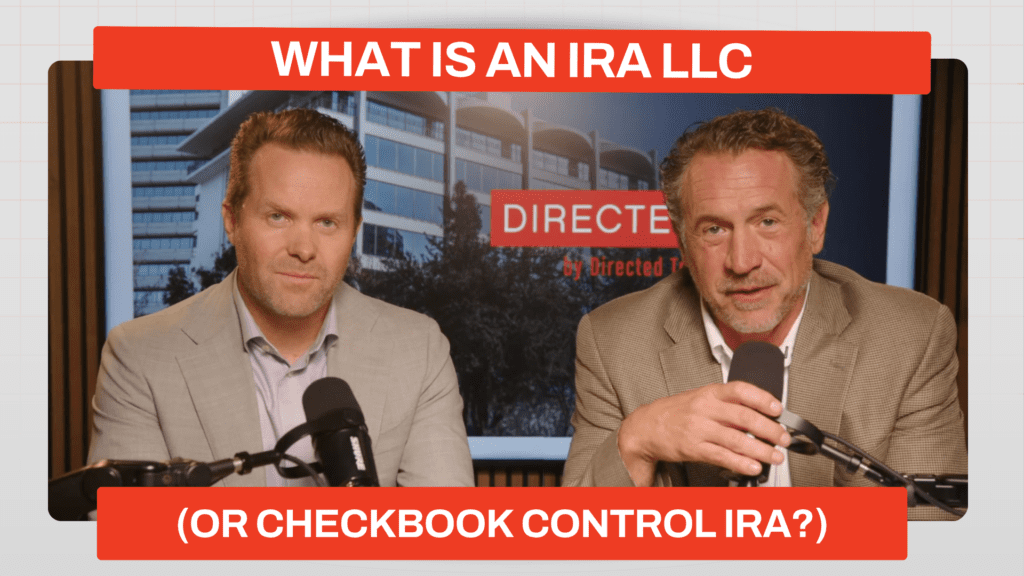
What Is an IRA LLC?
Mark J. Kohler:
There’s an optional step between funding the account and making the investment, and that’s the IRA LLC.
Instead of having the custodian approve every transaction one by one, your self-directed IRA can invest into a specially created LLC. That LLC is owned by the IRA, and it gives you more control and speed.
This is sometimes called a checkbook control IRA LLC.
The LLC can:
At some point, if you want, the LLC can be closed and the funds can go back to the IRA.
Is a Self-Directed IRA Complicated?
Mat Sorensen:
People hear “IRA LLC” or “prohibited transaction” and think this must be incredibly complicated.
It isn’t. I always tell clients it’s like learning a new board game. It feels unfamiliar at first, but once you learn the rules and do it once or twice, it becomes very manageable.
We have thousands of clients who use these structures successfully.
The Most Important Rule: Avoid Prohibited Transactions
Mat Sorensen:
Now let’s talk about the biggest rule: the prohibited transaction rule.
The principle is simple. Your IRA is supposed to benefit your IRA, not benefit you personally right now.
That means:
-
You cannot buy a property in your IRA and stay in it
-
Your spouse cannot use it
-
Your kids cannot rent it
-
Your parents cannot buy or sell it with your IRA
-
You cannot personally profit because your IRA made the investment
The investment must be strictly for the benefit of the retirement account.
Who Is a Disqualified Person in a Self-Directed IRA Transaction?
Mat Sorensen:
Certain people are considered disqualified persons. These generally include:
Those people cannot buy from, sell to, borrow from, lend to, or personally use assets owned by your IRA.
Siblings, aunts, uncles, and cousins are not automatically disqualified, but just because something may technically be allowed does not always mean it is wise.
Can You Do the Rehab Work Yourself on an IRA Flip?
Mat Sorensen:
No. If your IRA buys a flip, you cannot do the labor yourself.
You cannot put on the tool belt, do the demolition, install the flooring, or personally improve the property. The IRA can hire contractors, handymen, and vendors to do the work, but you cannot provide the sweat equity.
Mark J. Kohler:
Some people get hung up on that. They say, “But I’m in the flip business. My edge is doing the work myself.”
I understand that. But compare the return to what your IRA is currently doing. If your retirement money is sitting in a mediocre investment and you could still earn a better return by doing a flip with hired contractors, it may still be a far better use of your retirement funds.
Can a Real Estate Agent Earn a Commission on an IRA Purchase?
Mat Sorensen:
This is another common question.
If you are a licensed real estate agent and your IRA is buying a property, you cannot take the commission personally.
Even if the seller is paying the commission, you are still financially benefiting because your IRA made the deal happen. The IRS does not allow that.
A common solution is to waive the commission and negotiate a lower purchase price so the IRA benefits instead.
Example: How Mark Bought a Rental Property in an HSA
Mark J. Kohler:
Let me walk through my HSA rental example a little more clearly.
I originally opened an HSA at a bank. Later, I moved the HSA funds to a self-directed HSA custodian because I wanted to invest in real estate.
Then I created an LLC that was 100% owned by the HSA. The HSA funded the LLC, and the LLC opened its own bank account.
From that LLC bank account, I sent funds to closing and bought the property in the name of the LLC. I also signed a promissory note for seller financing, and I hired a property manager because I couldn’t personally manage the rehab work or provide labor.
The rent came in, expenses were paid, and the net income stayed inside the LLC. From there, the funds could later be sent back to the HSA.
That’s the structure.
Example: How Mat Bought a Rental Property with an IRA LLC
Mat Sorensen:
Mine was similar.
My self-directed retirement account funded an LLC, and that LLC bought the Indianapolis rental property. The LLC had its own bank account. Rental income went into that account, expenses came out of that account, and the property manager handled the day-to-day operations.
When I sold the property, the sale proceeds went back into the LLC, not to me personally.
That’s one of the most important concepts here: the money stays inside the retirement structure.
Can You Self-Manage Property Owned by an IRA?
Mat Sorensen:
Yes, in some situations you can self-manage administrative tasks, like:
But you still cannot perform the physical labor or personally compensate yourself. Many people still choose to hire a property manager, especially if the property is out of state.
Example: How Private Lending Works in an IRA LLC
Mat Sorensen:
Let me give one more private lending example.
I lent money from my IRA LLC to a real estate investor who was buying a distressed property that a bank would not finance. I visited the property, reviewed the deal, understood the value-add plan, and felt comfortable with the collateral.
The loan was secured by the property, and I charged 12% interest and 2 points. The borrower rehabbed the property, sold it, and paid off my IRA LLC. Then I redeployed that money into another loan shortly after.
That’s the appeal of private lending in a self-directed IRA. It can be passive, secured by real estate, and repeatable if you build relationships with experienced borrowers.
How to Find Private Lending Deals for a Self-Directed IRA
Mat Sorensen:
A lot of people say, “I don’t know anyone who needs to borrow money.”
Go to your local real estate investor association meeting and tell people you’re interested in being a private lender. You will probably meet several borrowers very quickly.
That said, use caution. Do your due diligence. Look at the property, the borrower’s experience, the lien position, and the overall risk.
What Kind of Returns Can Private Lending Produce?
Mark J. Kohler:
One reason people like private lending is the math.
If you are charging 12% interest and 2 points, and your borrower turns the loan in six months, the annualized return can be very strong if you keep redeploying the capital.
Of course, every deal has risk. There is no such thing as a risk-free return. But when your loan is secured by real estate and structured properly, many investors feel more comfortable than they would with an unsecured investment.
Mat Sorensen:
Exactly. And if you understand the Rule of 72, you know how powerful compounding can be when you’re consistently earning strong returns inside a tax-advantaged account.
Final Takeaway: You Can Invest Retirement Money in Real Estate
Mat Sorensen:
The bottom line is this: if you know real estate and believe in it as an asset class, you can use your IRA or 401(k) to invest in it.
A self-directed IRA gives you the ability to buy:
You just need to follow the rules, avoid prohibited transactions, and structure the investment properly.
Mark J. Kohler:
You do not have to accept whatever Wall Street happens to put on the menu. If real estate is the asset class you understand best, your retirement account can participate in it too.
Mat Sorensen:
That’s what we do every day at Directed IRA. We help clients use retirement funds to invest in assets they actually know and believe in.
Until next time, stay calm and self-direct on.