Most people treat a health savings account like a debit card for copays. They put money in, take the deduction, and spend it at the pharmacy, or leave it sitting in cash earning almost nothing. That habit can cost more than half a million dollars over a career.
The HSA is the only account in the tax code that’s tax-free going in, tax-free as it grows, and tax-free coming out for medical expenses. Not even a Roth IRA does all three. And starting in 2026, millions more people qualify for one.
Mat Sorensen, CEO of Directed IRA and tax attorney, covers the 2027 limits, who’s newly eligible, the strategies that turn an HSA into a retirement account, and where to hold it in the video below.
The 2027 HSA Limits
For 2027, you can contribute $4,500 with self-only coverage or $9,000 with family coverage, which can be you and a spouse or you and a dependent. At 55 or older, you can add a $1,000 catch-up. If you and your spouse are both 55 or older, each of you can add $1,000, but the second catch-up has to go into the other spouse’s own HSA. That’s up to $11,000 a year for an older couple.
To contribute, you need to be covered by a high-deductible health plan (HDHP):
| 2027 limits | Self-only | Family |
|---|---|---|
| HSA contribution | $4,500 (2026: $4,400) | $9,000 (2026: $8,750) |
| Catch-up, age 55+ | $1,000 | $1,000 per eligible spouse |
| Minimum HDHP deductible | $1,750 (2026: $1,700) | $3,500 (2026: $3,400) |
| HDHP out-of-pocket maximum | $8,700 (2026: $8,500) | $17,400 (2026: $17,000) |
Source: IRS Revenue Procedure 2026-24. The $1,000 catch-up isn’t adjusted for inflation. You can make 2026 HSA contributions until April 15, 2027.
There’s no income limit on the HSA deduction. Whether you earn $50,000 or $5 million, you get the full deduction. (See all of the 2027 contribution limits.)
Who’s Newly Eligible
The One Big Beautiful Bill expanded who can have an HSA, and the change that matters most is for people who buy their own coverage. Starting in 2026, bronze and catastrophic plans count as HSA-compatible. Bronze plans are the most popular tier on the individual marketplace, so millions of self-employed people and early retirees who buy their own insurance can now contribute to an HSA.
- Treated as HSA-compatible, even if they don’t meet the usual HDHP rules
- Applies whether or not you buy the plan through the marketplace
- Certain direct primary care arrangements no longer block HSA contributions
- You can pay the periodic fees from your HSA tax-free
- Telehealth before you meet your deductible no longer disqualifies you
- Made permanent for plan years starting in 2025
One thing still ends HSA contributions: Medicare. Once you enroll in any part of Medicare, usually at 65, you can’t contribute anymore. If you keep working past 65 with employer coverage and delay Medicare, you can keep contributing. Be careful when you claim Social Security after 65, though, since that automatically enrolls you in Medicare Part A.
The Triple Tax Advantage
Every other account gives you one or two tax breaks. The HSA gives you three.
| Deduction in | Tax-free growth | Tax-free out | |
|---|---|---|---|
| HSA | Yes | Yes | Yes |
| Traditional IRA or 401(k) | Yes | Yes | No |
| Roth IRA or Roth 401(k) | No | Yes | Yes |
| Taxable account | No | No | No |
The HSA is the only account with all three tax breaks, and its deduction has no income limit. Withdrawals are tax-free for qualified medical expenses incurred after the HSA was opened. Traditional IRA deductions can be limited at higher incomes, and Roth withdrawals must be qualified.
In dollars: a $9,000 family contribution in a 30% combined federal and state bracket saves about $2,700 in income tax. If you contribute through payroll at work, you also skip the 7.65% Social Security and Medicare tax, about $689 more.
That’s why, for anyone who qualifies, the HSA is one of the first accounts to fund. The usual exception is a 401(k) match, which doubles your money on day one. After the match, the HSA deserves the next dollars.
Strategy 1: Don’t Spend It
Here’s where most people leave money on the table. They contribute, take the deduction, and then spend the HSA on this year’s medical bills. That drains the one account where investment growth is never taxed.
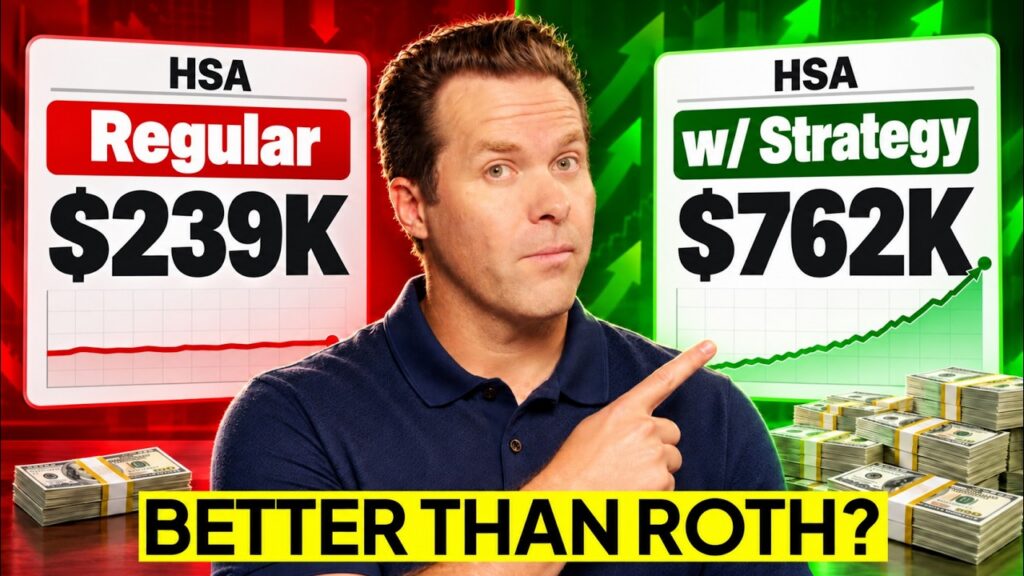
Instead, pay today’s medical bills from your checking account and leave the HSA invested. Say you start at 40, contribute the $9,000 family limit each year, and earn a hypothetical 9% a year. By 65, the HSA would be worth about $762,000: $225,000 of contributions and $537,000 of growth the IRS never touches. Leave the same money in a bank HSA earning 0.5%, and you’d have about $239,000.
Hypothetical illustration: family-limit contributions at the end of each year, with constant returns that aren’t guaranteed. Real returns vary, and investments can lose value.
Add the $1,000 catch-up from 55 to 65, and the age-40 example grows to about $778,000.
Strategy 2: Keep Your Receipts
You might be wondering how the money comes out if it’s only tax-free for medical expenses. The answer is the receipt strategy. The IRS doesn’t require you to reimburse yourself in the year you have the expense. As long as the expense was incurred after you opened your HSA, you can reimburse yourself years or decades later, tax-free.
Use regular money for today’s doctor, pharmacy, and dental bills.
Keep records of qualified expenses from the date your HSA was opened.
Contributions and growth stay invested, and nothing hits your tax return.
Pull out the total of your saved receipts whenever you want, even decades later.
So 25 years of family medical bills, paid out of pocket and documented, become 25 years of tax-free withdrawals you can take whenever you want. The money stayed invested the whole time. Just remember that expenses from before the HSA was opened don’t count, which is one more reason to open one as soon as you qualify.
In retirement, an HSA can also pay many Medicare premiums and long-term care insurance premiums, up to IRS limits, and medical costs tend to rise as we age.
Bank, Brokerage, or Self-Directed HSA
Where your HSA is held matters as much as how much you put in. And unlike a 401(k), you can move your HSA whenever you want, even if your employer chose the provider and contributes to it.
- Fine if you spend contributions right away
- Earns little or nothing if you leave money in it
- Invest in index funds and other public markets
- Often a minimum cash balance before you can invest
- Real estate, private companies, notes, and crypto
- Same tax benefits, plus the prohibited transaction rules
A bank HSA is fine if you spend contributions right away. A brokerage HSA lets your money grow in index funds and other public investments. A self-directed HSA, which is what Directed IRA offers, can also own real estate, private companies, notes, and crypto. The same prohibited transaction rules that apply to self-directed IRAs apply here: the HSA can’t buy property you use or deal with you or close family members.
If You Can’t Invest It Yet
These strategies don’t work for everyone, and that’s OK. If you’re paying down debt or your budget doesn’t leave room to pay medical bills out of pocket, still use the HSA. Contribute, take the deduction, and spend it on medical bills as they come. Start leaving money invested once your budget allows.
A high-deductible plan also isn’t right for everyone. If you or a family member has significant medical needs, the health coverage matters more than the tax savings.
Two Rules to Know Before 65 and After
At 65, the penalty goes away. Before 65, money taken out for nonmedical expenses is taxed and hit with a 20% penalty. After 65, nonmedical withdrawals are just taxed as income, like a traditional IRA, and medical withdrawals stay tax-free.
HSAs don’t pass well to children. If your spouse is the beneficiary, the HSA simply becomes theirs. Anyone else gets the full balance as taxable income in the year you die. So plan to spend your HSA down in retirement, or name your spouse, and leave Roth IRAs to your kids instead.
The Bottom Line
The HSA isn’t a medical spending account. Used well, it’s the most tax-efficient retirement account you can own, and the tax code just opened it up to millions more people. Contribute if you qualify, pay today’s medical bills from other money, keep your receipts, and let the HSA compound.
And if you want your HSA to invest in more than a fund menu, a self-directed HSA from Directed IRA can own real estate, private funds, and other assets you understand. For more on how to divide your savings among accounts, see Roth IRA vs Roth 401(k).

The 2027 limits, who’s eligible, the don’t-spend and receipt strategies, and how to invest your HSA in assets you know.
Download the Free GuideOr book a free 15-minute callDirected IRA is a Tradename of Directed Trust Company. Directed Trust Company performs the duties of a directed custodian, and as such does not provide due diligence to third parties on prospective investments, platforms, sponsors or service providers and does not sell investments or provide investment, legal, or tax advice.