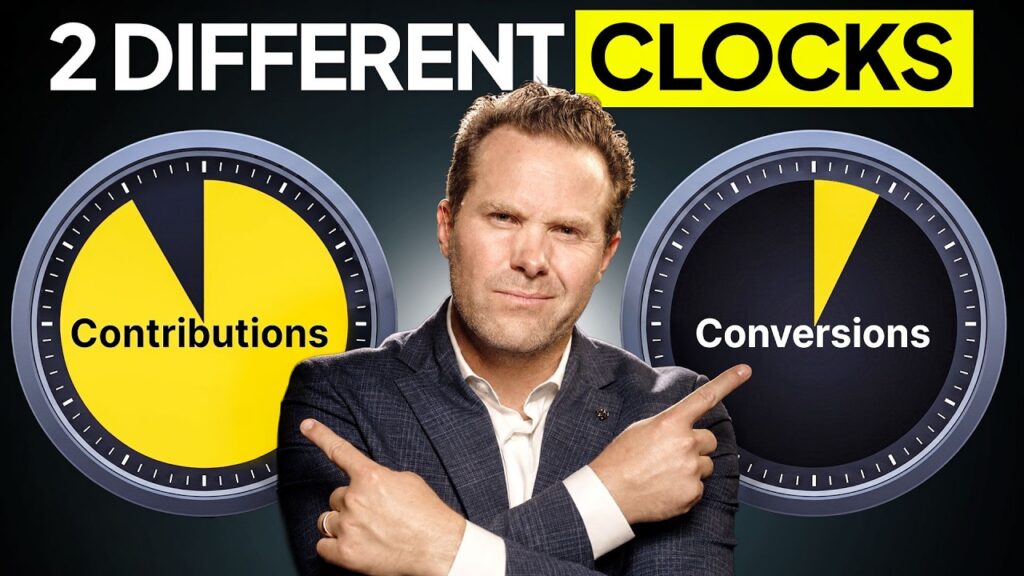
Your Roth IRA won’t be tax-free if you break either of two different five-year rules. Yes, two rules, running on two different clocks. Pull $50,000 of growth out of your Roth too early, thinking it’s tax-free, and it lands on your 1040 as ordinary income. In a 24% tax bracket, that’s $12,000 of tax on money that should have been yours forever.
These rules apply to more people than you might think: anyone with more than one Roth IRA, anyone who has changed custodians, anyone doing backdoor Roth contributions or Roth conversions before retirement, and anyone who opened their first Roth IRA later in life and assumes turning 59½ made everything tax-free.
Most people have heard of one five-year rule. Fewer know about the second, and the people who do often apply it to the wrong dollars. Mat Sorensen, CEO of Directed IRA and tax attorney, breaks down both clocks in the video below.
Two Clocks, Three Piles of Money
The real question is which clock applies to which dollars. Every Roth IRA can hold up to three kinds of money: contributions, conversions, and earnings. The two five-year rules treat each one differently. Some of your money is never locked, some unlocks on a schedule, and some stays conditional until a date most people can’t name.
Here’s the short version of both rules:
| Rule 1: Account clock | Rule 2: Conversion clock | |
|---|---|---|
| What starts it | January 1 of the tax year of your first-ever Roth IRA contribution or conversion | January 1 of the year of each conversion |
| How many clocks | One for life, shared by all your Roth IRAs | A separate clock for every conversion |
| What it controls | Whether earnings come out tax-free | Whether converted dollars face the 10% early withdrawal penalty |
| When it stops mattering | Never resets; once you’ve met it, it stays met | At age 59½ |
Rule 1 is about tax on your earnings. Rule 2 is about a penalty on converted dollars. Most five-year mistakes come from applying the right rule to the wrong pile of money.
Rule 1: The Account Clock
For earnings to come out of a Roth IRA tax-free, the withdrawal has to be a qualified distribution. That takes two things: you must have had a Roth IRA for five years, and you must be 59½ or meet another exception (disability, death, or up to $10,000 for a first-time home purchase).
The five-year clock starts January 1 of the tax year of your first-ever Roth IRA contribution or conversion. And it’s one clock for life. Every Roth IRA you open afterward inherits the same start date.
That means changing custodians doesn’t reset it. Say you had a Roth IRA at Fidelity for three years, then moved it to Directed IRA and bought real estate with it for three more. You didn’t blow up the clock. You have six years. The clock follows you through transfers.
Prior-year contributions help, too. If your first Roth contribution is made in April 2027 for the 2026 tax year, your clock starts January 1, 2026, so you reach five years in a little under four calendar years.
Turning 59½ Isn’t Enough
This is the one that catches people off guard. Say you open your first Roth IRA at 58. Now you’re 60. You’re past 59½, so you can take everything out tax-free, right?
Not yet. Turning 59½ removes the 10% early withdrawal penalty, but your earnings are still taxable until the account clock reaches five years. In this example, that’s around age 63. Your contributions can come out tax-free at 60 (or at any age). It’s the growth that has to wait.
Assumes the first Roth contribution is made at 58 for that year, so the account clock is met five years later, around age 63, depending on your birthday. Exceptions such as disability can change the timing.
Tax-free retirement income starts only when you’ve satisfied both tests: age 59½ and five years of having a Roth IRA, any Roth IRA, including time at a prior custodian.
Rule 2: The Conversion Clock
The second rule is narrower, and it’s the one people who do Roth conversions tend to get wrong. Every Roth conversion has its own five-year clock, starting January 1 of the year you convert.
This clock has nothing to do with income tax on the converted money. You already paid that: a 2026 conversion goes on your 2026 return as taxable income. The conversion clock exists so you can’t use a conversion as a loophole around the 10% early withdrawal penalty. Without it, you could convert on a Monday and withdraw on a Tuesday at 45, penalty-free.
So here’s the rule. If you take out converted dollars within five years of that conversion and you’re under 59½, the IRS charges the 10% penalty on the part of the conversion you paid tax on. Wait out the five years, and those converted dollars come out like a contribution: no tax, no penalty, at any age.
Example: Converting at 45
You’re 45, with a Roth IRA and a $100,000 traditional IRA. You convert the whole traditional account, pay the tax now, and let it ride. By 51, the conversion clock has run, and the converted money has grown to $150,000.
Can you take out the $100,000 you converted? Yes, all of it, with no tax and no penalty. You paid the tax at 45 and cleared the five-year window.
The $50,000 of growth is a different story. Those earnings fall under Rule 1 and the age-59½ test. Take them out at 51 and they’re taxed and penalized. In a 24% bracket, that’s about $17,000 gone from a $50,000 withdrawal.
Hypothetical example. The $17,000 assumes a 24% federal bracket plus the 10% penalty on $50,000 of earnings; state tax not included.
The Backdoor Roth: A Conveyor Belt of Clocks
A backdoor Roth IRA is a nondeductible traditional IRA contribution that you convert to a Roth. So every year’s backdoor is a conversion, with its own vintage and its own five-year clock, like bottles of wine aging in a cellar.
Say you do a $7,500 backdoor Roth every year. Your 2026 conversion clears in 2031, your 2027 conversion in 2032, and so on. Every January 1, another year’s chunk clears.
| Conversion | Amount | Clock clears |
|---|---|---|
| 2026 backdoor | $7,500 | January 1, 2031 |
| 2027 backdoor | $7,500 | January 1, 2032 |
| 2028 backdoor | $7,500 | January 1, 2033 |
| 2029 backdoor | $7,500 | January 1, 2034 |
| 2030 backdoor | $7,500 | January 1, 2035 |
Each conversion’s clock runs from January 1 of the year you convert. It matters only before 59½, and only for the part of each conversion that was taxable.
Six years into this strategy, you don’t have a Roth you can’t touch until 59½. You have a conveyor belt that releases another year of converted dollars every January.
One nuance worth knowing: the 10% penalty applies only to the part of a conversion that was taxable when you converted. A clean backdoor, where you convert a nondeductible contribution right away, often has little or no taxable amount. The clock matters most when part of the conversion was taxable, for example because you also had pre-tax IRA money and the pro-rata rule applied.
The Shut-Off Switch at 59½
The conversion clock shuts off at 59½. It only guards against the 10% early withdrawal penalty, and that penalty ends at 59½. So if you retire at 60 and run gap-year Roth conversions at 62 while your income is low, you don’t have to wait five years to touch the converted dollars. You could convert at 62 and spend it at 63.
But Rule 1 is still on. If you’ve never had a Roth IRA and you make your first conversion at 60, you can take out the converted amount, but the earnings have to wait until 65, when the account clock reaches five years. If you already had a Roth IRA in your 40s or 50s, you’ve probably satisfied Rule 1 already.
The Ordering Rules Work in Your Favor
When Congress created Roth IRAs, it did Roth owners a favor: withdrawals come out in a set order, from the safest dollars to the least safe.
- Regular contributions come out first. They’re always tax-free and penalty-free, at any age, and neither clock applies.
- Conversions come out next, oldest first. Once a conversion has cleared its five-year clock, it comes out tax- and penalty-free, even before 59½.
- Earnings come out last. This is the only pile that needs everything: age 59½ and five years under Rule 1.
You don’t pick which pile you’re taking from. The IRS applies this order across all of your Roth IRAs, so you can’t accidentally pull out earnings while contributions and conversions are still in the account.
Here’s how that plays out. You have a $200,000 Roth: $80,000 of regular contributions over the years, $70,000 you converted in 2019, and $50,000 of growth. You can take $150,000 today with zero consequences, even under 59½.
The $80,000 of contributions comes out unconditionally, and the 2019 conversion cleared its five-year clock on January 1, 2024. Only the $50,000 of growth is conditional, and the IRS won’t give it to you until the first $150,000 is out.
You track all of this on Form 8606, which you attach to your 1040 when you convert or take money out of a Roth IRA. Your custodian’s statements and your past 8606s are where these numbers live.
When You Can Stop Worrying
Don’t overthink this. A lot of people never need to worry about either clock:
- If you’re only taking out regular contributions, neither clock applies. Any amount, any age, any reason.
- If you’re over 59½ and have had a Roth IRA for five years, both clocks are done. Take the money out tax-free.
- If you’re 45 and don’t plan to touch the account until 60, both rules will be long satisfied by then. Contribute, invest, and enjoy the tax-free ATM later in life.
In practice, the five-year rules bite in two situations: taking out converted dollars too early, and opening a first Roth IRA late in life and assuming 59½ makes everything tax-free.
Common Questions
Does moving my Roth IRA to a new custodian restart the clock? No. Rule 1 is one clock for all of your Roth IRAs, and transfers and rollovers between Roth IRAs don’t reset it.
Does time in a Roth 401(k) count? Not toward your Roth IRA clock. A Roth 401(k) has its own five-year period. If you roll a Roth 401(k) into your first-ever Roth IRA, the IRA clock starts with that rollover, so it can pay to open a Roth IRA years earlier, even with a small contribution.
What about an inherited Roth IRA? The 10% penalty doesn’t apply to beneficiaries, but earnings are tax-free only once five years have passed from the original owner’s first Roth contribution. See how inherited Roth IRAs work.
The Bottom Line
The five-year Roth rule isn’t one rule, and it isn’t really about waiting. It’s about knowing which of your dollars are which. The tax code doesn’t see one Roth IRA. It sees three piles of money (contributions, conversions, and earnings) and two clocks, and it treats each pile differently. The people who get burned aren’t the ones who never heard of the five-year rule. They’re the ones who heard of it and applied it to the wrong pile.
And if you want your Roth doing more than sitting in mutual funds, it can own real estate, private funds, notes, and other assets you actually know, in a Roth IRA you direct yourself. Directed IRA handles the setup, and you stay in control of the account and what it invests in.
Regular contributions come out first, tax- and penalty-free at any age.
Under 59½, a conversion is penalty-free once five years have passed from January 1 of its year.
Earnings are tax-free only after five years and age 59½ (or another exception).
Past 8606s and custodian statements show your contribution and conversion totals.

Learn how your Roth IRA can own real estate, private funds, notes, and other assets you know, step by step.
Download the Free GuideOr book a free 15-minute callDirected IRA is a Tradename of Directed Trust Company. Directed Trust Company performs the duties of a directed custodian, and as such does not provide due diligence to third parties on prospective investments, platforms, sponsors or service providers and does not sell investments or provide investment, legal, or tax advice.