Welcome And The Big Promise
Mark Kohler 0:08
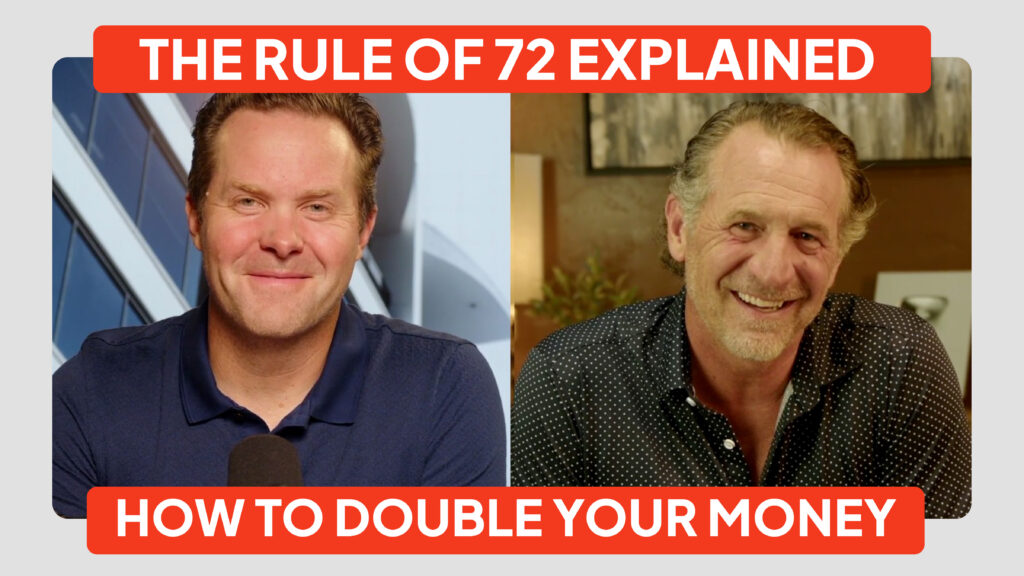
Welcome everybody to the Directed IRA podcast. My name is Mark Kohler, and I’m here with the infamous Matt Swanson, CEO of Directed Trust Company and author of the Self-Directed IRA handbook. Third edition? Is it the third edition’s out, right?
Mat Sorensen 0:23
Third edition’s out, yeah. Go get your copy. It’s on Amazon or MattSorwensen.com.
Mark Kohler 0:27
Wow, a little shameless plug there. Today we are going to explain the most incredible tool in building your retirement account, and it’s an algorithm, a calculation, an equation, a method of madness that will blow your mind. Matt Sorensen.
Mat Sorensen 0:46
Have you heard of the rule of 72 and how your money doubles over time? Well, I think this rule is the easiest thing to have in the back of your mind you’re investing, compounding, growing money, whether this is your IRA, your 401k, your HSA, your brokerage account, any asset, your real estate investments, I don’t care what it is. How is that money growing over time? Well, it’s the rule of 72 you should have in the back of your mind and thinking about as you’re penciling out deals and investment opportunities. And we’re going to break it down in today’s
The Snowball Visual For Growth
Mat Sorensen 1:18
episode.
Mark Kohler 1:18
Well, as we go throughout this discussion today, I want to give you a visual. And I love the visual of a snowball. And I frankly, I’ve got to give it to the man, the myth, the legend, Dave Ramsey, because he is taught in a modern setting today probably the concept of interest and the power of interest more than anyone else I know. And it clicked for me when he used that snowball example. I want you to think of the incredible, infamous movie Willow, directed by Ron Howard, his breakout movie with Val Kilmer, who played Mad Martin. Now, in that show, he’s being chased by the bad guys and jumps off a cliff in the snow and with Willow, and he starts to turn into a snowball as he goes down the hill. For anybody that’s seen this, it’s quite amazing. But but the uh physics of this is every time that snowball turns over, it gets more and more snow. And so, although it was the size of Val Kilmer when he jumped off the hill, it quadrupled in size because every time it turned over, it gained more snow, even though it was only one turn of the snowball. And that’s the power of 72, as we explain it here, is that snowball is only going to turn over once, but how much snow are you going to collect when it turns over? And that’s the visual I want you to think about.
Compound Interest And The Rule
Mat Sorensen 2:41
Yeah, and I think um Albert Einstein, Mark’s going to Willow, I’m and Steven Spielberg, I’m going to Albert Einstein, okay? Albert Einstein is famous for saying compounding interest is the eighth wonder of the world. He who understands it earns it. He who doesn’t pays it. Now, as we’re thinking of investing, we’re thinking of investment returns. This is interest, what you’re making, and how it’s going to grow over time each year is compounding. All right. So what the rule of 72 does is you say, all right, what is my return on this investment? Interest, think of it here, let’s say 10% rate of return, 10% interest. All right. Well, if I’m getting a 10% rate of return, how long does it take for my money to double? If I had $100,000, how long at a 10% rate of return does that turn into $200,000? Well, the rule of 72 is a quick equation. You divide 72 by your rate of return, 10 in this example, and that tells you your money is going to double in 7.2 years. Because 72 divided by 10 is 7.2. So my $100,000 will become $200,000 in 7.2 years. So this is what Albert Einstein said, he who learns this earns it. And if you’re on the other side of it, if you don’t learn it, you actually are the one paying it. So if we’re thinking of investing, I’m thinking about my IRA and growing my self-directed accounts or any other investment I’m making, I’m really conscious of this number because I’m thinking about long-term growth and compounding.
How Faster Returns Change Everything
Mark Kohler 4:19
Okay. Now I love that foundational example. And 7.2 years to double your money. Well, let’s say the ROI goes up to 15%, because you have an alternative investment that you know about, and you can get a better return than what all Wall Street or some other option is offering you. If you get a 15% ROI, you take 72 divided by 15, and it tells you that that money will double in 4.8 years. Now, in my investment calculator here, when Matt said 100 grand, 10% return, it would double in 7.2 years. In 10 years, I would have 259,000. See it doubled, went to 200, and then got this little extra 59,000 between 7.2 and 10. Well, if I go to 15% rate of return, now that money doubles every 4.8 years. And in that same 10-year period, I’m sitting on $404,000 instead of the $259. That’s the impact of the ROI and lets you know how quickly that snowball is going to get more snow.
Mat Sorensen 5:31
Yeah, and I think when we are looking at our IRA or 401k in particular, or whatever investment account, we’re always thinking about long-term perspective, right? If you’re putting money in your IRA or 401k, you should not be thinking about how do I make money in this next year? Well, this compounding effect of the dollars that are earning, like what you make in year one and all that profit rolls in. No taxes. Okay, there’s there’s no haircut on
Private Lending Example In An IRA
Mat Sorensen 5:58
your rate of return. Okay, and this is why I like IRAs in 401ks. Let’s let’s take a quick example here. I don’t want to flesh this out. Okay, so I’m I private lend my money out of my self-directed IRA, and I charge 12% interest plus two points, and I lend that under six-month terms. So when I lend out $100,000, I get two points, $2,000, plus I get 12% interest, all right, which is over an annual year, but I do it under a six-month loan. When that money gets paid back, I reloan it out again and I get my two points. What I’m saying here is I actually get a 16% rate of return because I get a charge point. Okay. So I’m getting a 16% rate of return on my money.
Mark Kohler 6:41
Well, now what’s cool about this?
Mat Sorensen 6:43
Well, let me let me say let me say this here before we get to the numbers, I want to make an important tax point. If I’m doing that out of my IRA, I made 16%. That $16,000 I got in that first year, every penny gets reinvested. But let’s say I was doing that lending personally with taxable dollars. Well, I’m in a 40% tax rate between state and fed. When I lend out and I make 16 grand, I lend out 100 grand at 16%. I don’t get to keep $16,000. I’ve got to send 40% of that to the IRS. I’m only keeping 16% of 16,000, or sorry, I’m only keeping 60% of $16,000, which is $9,600. I have a 9.6 return. So let’s show how your money doubles, okay, at a 16% rate of return, 72, excuse me, divided by 16, that’s four and a half years. So in my IRA, where I’m not paying taxes, and I use a Roth because it comes out tax-free too, my money doubles every four and a half years. In my non-retirement account dollars, though, when I invest 100 grand, I’m only getting 9.6 because I got to pay taxes on it. I got a silent partner, the IRS, in the state, my money doubles every 7.5 years. It takes me almost twice as long for my money to double in a taxable account or with taxable dollars versus my IRA.
Mark Kohler 8:12
Okay. I love it because you’re going, you’re setting the groundwork for what uh
Tax Drag Versus Tax Free Compounding
Mark Kohler 8:17
an example I want to give too. But I was going to just reiterate what Matt said. Um, I did some research, just I’m going to share a little point here. Um, my sister is doing some investing. And she said, Hey Mark, what can I expect generally on average, if I invest in Wall Street products? I don’t know what to do. What should I invest in? How much is my ROI gonna be? And I said, Well, let’s look at that after fees, and so I said, I think the quote unquote safest, most reliable, and less less uh least costly investment is an S P 500 ETF, exchange traded fund, low fees based on the SP 500. As I AI’d that right ways and left ways and went on on the web all over the place, after costs of the investment banking establishment, you’re gonna average about 9% with an SP 500, no you know, low-fee ETF. Well, Matt, people, let’s compare this, is doing 16% with no cost because he’s individually lending this out twice a year with a first trust deed as a guarantee that if he doesn’t get paid, he’s gonna make even more. He’s gonna take that house back. But we’ll set that risk issue aside. I would consider Matt’s strategy much less risky. So 9% return over 20 years on that $100,000, you would have $560,000. But if I got that 16% return that Matt’s doing, it turns into $2 million. So that 16%, I just wanted to highlight that, is dramatically, um it makes such a dramatic impact over this 20-year period because Matt said these subtle words. He said, the long haul and getting the best ROI can do. That’s why we like self-directing, because you can choose. Um but my subtle point too, Matt, was had to deal with cost, not taxes. Matt said, let’s not, let’s not have taxes and put it in a Roth IRA. I’m saying when you self-direct and use alternative asset investing, a lot of times your costs are going to be less than Wall Street as well. So you’re reducing your costs, you’re eliminating tax, and you’re driving up your ROI. That’s like a trifecta. We ought to use that word.
Mat Sorensen 11:00
Yeah. Yeah. Who’s got the trademark on that? Um yeah, and I think, you know, obviously investing is is, I mean, this is how we grow and build wealth. We can all go work our butts off and earn money, whether we’re we have a job or a business, and you know, we got to hustle and go get that money, set it aside and invest it. But I want you to be thinking about like, how do your dollars work harder for you? You know, like I we want to think about like, how’s my money working for me? Not me working for me. So if my money’s working for me, I want to do it in the most efficient way, which in our opinion is tax-advantaged accounts because there’s no tax drag. I want to invest it in the assets that I think can perform the best. Maybe that is the stock market. I don’t know. And maybe maybe you have a perspective that the stock market’s gonna be better in 26, 27 than it, then, than other assets. I I don’t know. And you know, that nobody knows. Precious metals was the best performing asset last year. Who knew that? A couple years before it was crypto. Who knew that? Before that, it was private equity. Now it’s um now the stock market’s actually had a good year. Is it running out? And so and real estate back in 2022 crushed everything else. So all these assets have their season and time, but the nice thing about self-directing and what we do every day, what many of our clients at directed IRA are doing is you can invest in whatever you want. You want to go in the stock market with your account? Great. That’s the time you feel like the that’s the right place you want to be. You want to do a real estate deal where you want to own the property, you want to do private lending as we talked, just talked about, invest in a private fund, precious metals, crypto, whatever your perspective of. Everyone’s trying to figure this out. But we want those to have, we want to be able to have the freedom to invest in the asset that has the greatest ROI, not be put in a box before it’s only the stock market, which is most broker dealer IRAs. We also want to use the tax advantaged account because we don’t like the tax drag and the IRS or the state chopping away at our return, which as we’ve talked about, depletes these dollars over time drastically. And what are the fees you’re paying? The Wall Street fees can add up. You’ve got an advisor, of course, you’re there’s a cost for that, and they’re providing a service too. If you’re in a lot of these ETFs or these publicly traded funds, there’s fees in those things. Like when Mark talked about an ETF, are they the low cost fees funds or what are those costs in that? And your self-directed IRA, it’s very straightforward what the costs are, because it’s a flat annual fee that we have, which is $495. So I think when you add all that together, I’m just saying, like, this is why I like to self-direct my own retirement account dollars. I like to be able to invest in the best investment I can find, not just what’s on the publicly traded asset menu. And I like knowing those dollars are in accounts that are the most tax efficient in terms of growth and how they’re going to come out, which in my opinion is the Roth.
Mark Kohler 13:54
Wonderful points.
Self Directing For ROI And Lower Fees
Mark Kohler 13:55
Um, I just want to add one last perspective. And Matt said, I want my money working harder for me. Well, I want you, our listener, not working so hard. Like I want the money working hard, but I don’t want you working so hard. And the opposite of that, or the higher and best use of you of this process is for you to work smarter, not harder. And working smarter is listening to podcasts like this. We want to compliment you. We are preaching to the choir. You are here because you get it, and you’re wanting to have it sink in more, you’re wanting to assimilate this, you’re wanting to learn anything you can that gives you an edge. Well, the edge today is saying, okay, if I can keep costs or fees down, if I can double my money faster, if I can do it in a tax-free vehicle, and I can do it with the latitude of investing what I know best and maybe even creating a less risky investment, people, now you’re working smarter. And it doesn’t take that much more time or effort. It just means paying attention. And so I want to say thank you for being here because this is going to make the difference to your long-term wealth.
Mat Sorensen 15:25
Yeah, and uh thank you everybody
Work Smarter And Next Steps
Mat Sorensen 15:27
for um getting through to this. If you’re still listening right now, I think you learned something and liked it. I don’t know, or maybe you’re just like hate watching, whatever, whatever it is. Just subscribe, give us some thumbs up, share us with your friends and family. Let us know if we can be a resource at directed IRA. You can book a free call with our team at directeddira.com. We’d love to help you walk through how you can use self directed accounts and use those to grow and build your financial future. We will see you next time. Thanks for being here.