Required minimum distributions get described as a tax bomb waiting for you at 73. For most retirees, the math is much less dramatic. Your RMD is your traditional account balance divided by a number from the IRS, and in the first year it works out to just under 3.8% of the account. That’s less than the 4% many retirees plan to withdraw anyway.
Mat Sorensen, CEO of Directed IRA and tax attorney, says RMDs only become a real tax problem in two situations: a traditional IRA or 401(k) worth more than about $2 million, or a large balance combined with significant other income in retirement. In the video below, he shows how to calculate your own RMD in about two minutes and runs a three-part test to see whether it will actually cost you anything.
How to Calculate Your RMD
Take your traditional IRA and 401(k) balances as of December 31 of the prior year and divide by the factor for your age in the IRS Uniform Lifetime Table. At 73, the factor is 26.5.
| Traditional balance on Dec. 31 | RMD at 73 (balance ÷ 26.5) |
|---|---|
| $330,186 (average balance at 65+) | $12,460 |
| $500,000 | $18,868 |
| $1,000,000 | $37,736 |
| $1,500,000 | $56,604 |
| $2,000,000 | $75,472 |
Traditional IRAs, SEP and SIMPLE IRAs, and traditional 401(k)s count. Roth IRAs don’t, and Roth 401(k)s no longer have RMDs. Average balance from Vanguard’s How America Saves 2026 report.
A $500,000 balance means an RMD of $18,868, or 3.77%. If the account earns more than that, it can keep growing even as you take your RMDs. At $2,000,000, the RMD is $75,472, and that’s where it starts to matter, especially with other income on top.
RMDs start at 73 if you were born between 1951 and 1959, and at 75 if you were born in 1960 or later. Your first RMD can wait until April 1 of the following year, but then you’ll take two in the same year. After that, each RMD is due by December 31. Miss one and the penalty is 25% of the amount you should have taken, cut to 10% if you correct it promptly.
A few rules help. You can add up the RMDs for all your traditional IRAs and take the total from any one of them. RMDs from 401(k)s are calculated and taken separately for each plan. Roth IRAs have no RMDs during your lifetime, and since 2024, neither do Roth 401(k)s.
The Percentage Rises With Age
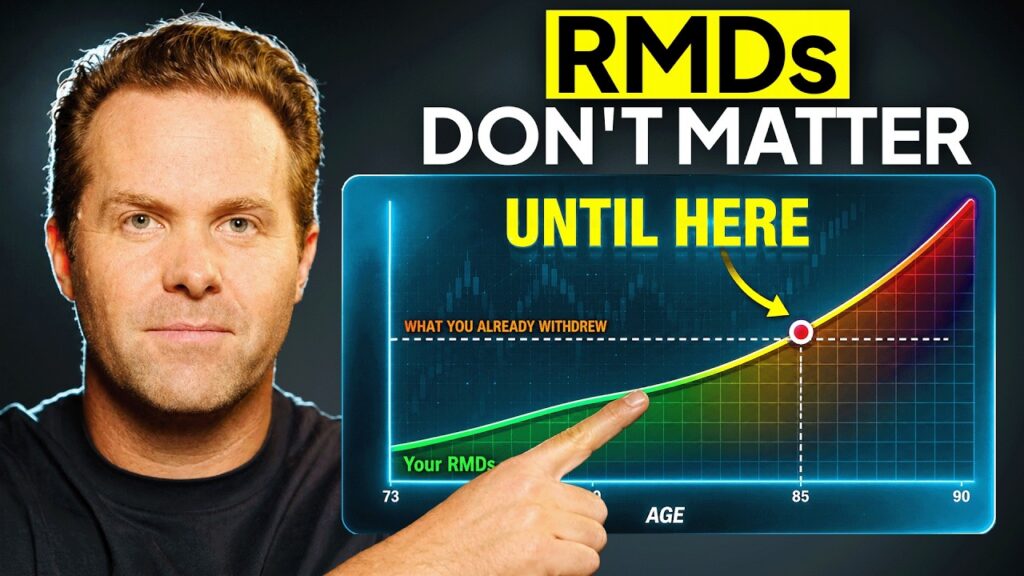
The factor shrinks each year, so the required percentage grows:
From the IRS Uniform Lifetime Table, used by most IRA owners. A different table applies if your spouse is the sole beneficiary and more than 10 years younger.
By your mid-80s, you’re required to take out about 6%, and by 90, about 8%. That’s also the stage of life when most people expect to be spending down their accounts anyway.
Mat’s Three-Part Test
Whether an RMD costs you anything depends on three things, not just the balance.
Under about $2 million, the forced amount is usually modest.
If you already take 4% or more to live on, the RMD changes little.
Watch the jumps from 12% to 22% and from 24% to 32%.
1. How big is the balance? Most retirement accounts aren’t near the danger zone. Vanguard’s How America Saves 2026 report puts the average balance for people 65 and older at $330,186. At 73, that’s an RMD of about $12,460.
2. What were you going to withdraw anyway? The whole point of saving in an IRA or 401(k) is to live on it in retirement. Say you have $1 million and take $60,000 a year to live on. Your first RMD is $37,736, about 40% less than you’re already taking. If the balance stays flat, the RMD doesn’t catch up to your $60,000 until about 85. The RMD only forces your hand if you weren’t planning to take money out.
3. Where does the income land? Most bracket steps are small, like 10% to 12%. Two are big: 12% to 22%, which starts above $100,800 of taxable income for married couples filing jointly in 2026 ($50,400 single), and 24% to 32%, which starts above $403,550 for couples ($201,775 single). An RMD that pushes you across one of those lines costs more.
Two Couples, Same IRA
Here’s how the same $1 million IRA plays out for two retired couples, both 73:
| Married, both 73 | Couple A | Couple B |
|---|---|---|
| RMD from a $1 million IRA | $37,736 | $37,736 |
| Social Security | $70,000 | $70,000 |
| Other income | $40,000 | $90,000 |
| Taxable income after deductions | about $89,700 | about $144,200 |
| Bracket the RMD lands in | 12% | Mostly 22% |
2026 federal brackets for married couples filing jointly. Up to 85% of Social Security is taxable. Deductions are the $32,200 standard deduction, $3,300 in age-65 add-ons, and the senior deduction of up to $6,000 each, which phases out above $150,000 of income. Simplified, hypothetical illustration; your return will differ.
Couple A stays in the 12% bracket. Couple B has more income from part-time work, consulting, or rentals, so most of their RMD is taxed at 22%.
One wrinkle: extra income can make more of your Social Security taxable, so an RMD can cost more than the bracket suggests. In this example, Couple A’s RMD adds about $7,800 of federal tax, around 21% of the RMD, even though they’re in the 12% bracket. A tax advisor can run your actual numbers.
When RMDs Are a Real Problem
For the people who do face a problem, Mat calls it a luxury problem. A large traditional balance that keeps compounding faster than the RMD percentage creates bigger RMDs every year, and higher brackets with them. Two strategies help.
Give from your IRA. A qualified charitable distribution (QCD) sends money straight from your IRA to a charity. It counts toward your RMD and stays out of your taxable income. That matters because most people now take the standard deduction, so a regular donation from their bank account doesn’t lower their taxes at all.
| Giving $12,000 to charity | Check from your bank account | QCD from your IRA |
|---|---|---|
| Lowers your tax if you take the standard deduction | No | Yes |
| Counts toward your RMD | No | Yes |
| Federal tax saved in the 22% bracket | $0 | $2,640 |
Qualified charitable distributions are available from IRAs (not directly from a 401(k)) starting at age 70½, up to $111,000 for 2026. The money must go straight from the IRA to the charity.
Convert to Roth in the gap years. Many people retire in their 60s, years before RMDs begin. With no paycheck and no RMDs yet, their income, and their tax bracket, can be unusually low. That’s a good window to convert traditional money to Roth in chunks, for example $50,000 a year for five years. You pay tax at today’s lower rate, and the converted money grows tax-free with no RMDs. See the most common Roth conversion mistakes before you start.
Roth accounts avoid RMDs entirely, which is one reason Mat favors them for long-term savings. For the full comparison, see Roth IRA vs Traditional IRA: The Great Debate.
RMDs From a Self-Directed IRA
RMDs work the same way in a self-directed IRA, with two extra things to plan for when the account holds real estate, private companies, or other assets that aren’t cash:
- The value matters. Your RMD is based on the account’s value on December 31, so private assets need a fair market value each year. See how self-directed IRA valuations work.
- Plan for liquidity. You can take the RMD in cash, so keep enough in the account, or take it in kind by distributing a share of an asset at its fair market value. Because IRA RMDs can be combined, you can also take the full amount from a different IRA that holds cash and leave the property alone.
The Bottom Line
For most people, RMDs aren’t a crisis. Divide your traditional balance by 26.5 to see your first one, compare it with what you already plan to withdraw, and check where it lands in your brackets. If you have more than about $2 million in traditional accounts, or a large balance plus significant other income, plan ahead with QCDs and gap-year Roth conversions.
If you want your IRA invested in real estate, private funds, or other assets you know before RMDs begin, Directed IRA can help. Open an account online or book a free 15-minute call.
How to invest your IRA in real estate, private funds, and other assets you know, step by step.
Download the Free GuideOr book a free 15-minute callDirected IRA is a Tradename of Directed Trust Company. Directed Trust Company performs the duties of a directed custodian, and as such does not provide due diligence to third parties on prospective investments, platforms, sponsors or service providers and does not sell investments or provide investment, legal, or tax advice. Examples on this page are hypothetical and for educational purposes only.