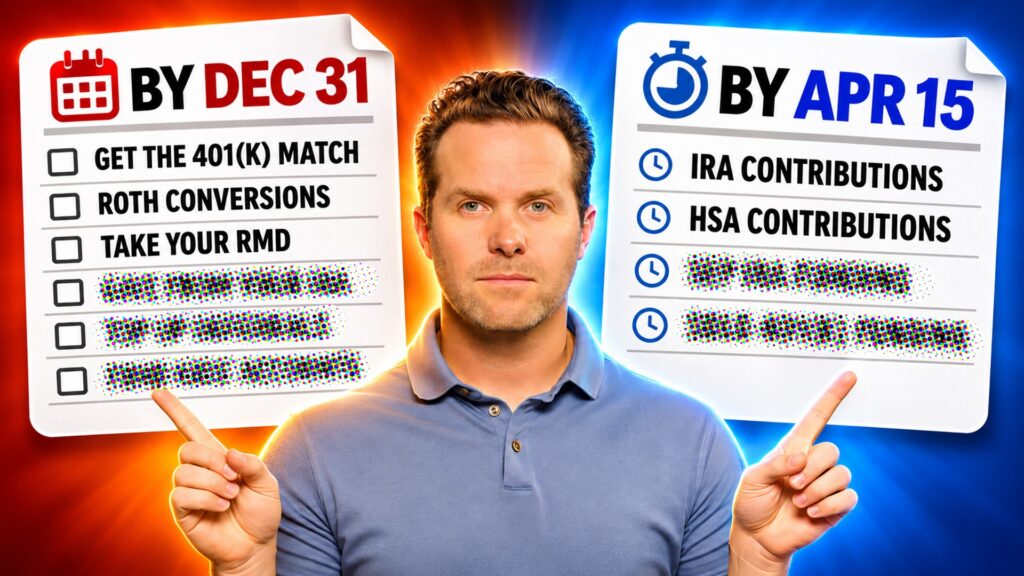
December 31st and April 15th are not interchangeable deadlines, especially when it comes to your retirement accounts. There are six moves that need to be completed by year-end to protect your employer match, manage Roth-conversion taxes, satisfy required minimum distributions, and take advantage of 2026 contribution opportunities. There are also four items that can safely wait until April 15th.
As CEO of Directed IRA, where we administer more than 25,000 retirement accounts, I can tell you December is our busiest month for new accounts, contributions, distributions, conversions, and investments. Savvy investors act in December for a reason: tax-planning opportunities disappear when the calendar turns.
In this article, I’ll break down the six retirement-account actions to prioritize before December 31st, 2026, followed by the four deadlines that do not require a year-end scramble.
Your Retirement Deadlines at a Glance
These deadlines come with important qualifications. Employee payroll deferrals and employer contributions follow different rules. SEP IRA and Solo 401(k) deadlines may extend.
1. Capture Your Full Employer 401(k) Match
When funding your 401(k), start with the money your employer is willing to contribute. For example, if you earn $100,000 and your employer offers a dollar-for-dollar match on contributions up to 4% of pay, you contribute $4,000, your employer contributes up to $4,000, and a total of $8,000 goes into your retirement account.
If you have contributed only $1,000, you would need another $3,000 in eligible employee deferrals to reach $4,000. But there is a catch: your plan’s matching formula matters. A plan that calculates the match each paycheck may not let you recover every missed matching dollar simply by making a larger contribution at year-end. Ask your administrator whether the plan provides an annual “true-up.”
For ordinary workplace 401(k) salary deferrals, the practical deadline is your remaining 2026 payroll, not tax-filing season. You cannot wait until January and retroactively defer wages that were already paid.
2. Complete Any Roth Conversion You Want Taxed in 2026
A Roth conversion moves eligible pretax retirement dollars into a Roth account. The taxable portion becomes income in the year of the conversion, and a conversion completed in 2027 cannot be designated as a 2026 conversion. That makes December 31 a planning deadline, not just an administrative one.
I recommend spreading a large conversion across multiple years rather than unnecessarily crowding income into one year, which can bump you into a higher tax bracket. For a married couple filing jointly in 2026, the 24% federal income-tax bracket ends at $403,550 of taxable income. With the $32,200 basic standard deduction, that leaves room for $435,750 of income before deductions before entering the 32% bracket.
Consider a married couple with $230,000 of income before a conversion. A $200,000 conversion would generate approximately $48,000 in additional regular federal income tax. Adding another $100,000 in the same year would put approximately $94,250 of that additional income into the 32% bracket.
Simplified illustration: basic standard deduction only, all income ordinary, no other adjustments or tax interactions.
Entering the 32% bracket does not make the entire conversion taxable at 32%. Only the income above that bracket’s threshold receives that rate. Converting $200,000 in 2026 and considering the remaining $100,000 in 2027 could therefore reduce the overall tax cost, depending on the couple’s actual 2027 income, deductions, and tax brackets.
The goal is not to convert the most money possible. It is to convert an appropriate amount at an acceptable tax cost.
3. Take Your Required Minimum Distribution
While some year-end moves are optional, a required minimum distribution is not. For owners reaching the applicable starting age in 2026, RMDs begin at age 73, and the annual deadline is December 31. Original Roth IRA owners do not have lifetime RMDs.
Miss a $10,000 RMD, and the potential excise tax is $2,500, or 25% of the shortfall. Timely correction can reduce that rate to 10%.
If you own multiple traditional IRAs, you can calculate each account’s RMD separately but withdraw the combined amount from one or more of those IRAs. For example, an investor with a traditional IRA at Directed IRA and another at Fidelity can satisfy the combined requirement from the more liquid account. That flexibility does not extend across separate 401(k) plans. Each 401(k) must satisfy its own RMD requirement.
4. Complete Your Qualified Charitable Distribution
If you are charitably inclined and at least age 70½, a qualified charitable distribution, or QCD, sends money directly from your IRA to an eligible charity. The qualifying amount is excluded from income and can count toward your RMD. For 2026, the QCD limit is $111,000 per eligible individual, or a combined $222,000 for a married couple if each spouse independently qualifies.
Suppose your annual RMD is $37,000, and you direct $20,000 from your IRA to a qualifying charity. The $20,000 is excluded from your taxable income and counts toward your RMD, and you still need to satisfy the remaining $17,000.
Coordinate the transfer directly with your IRA custodian. Taking a distribution personally and then making your own donation does not produce the same QCD treatment, and QCDs are not made directly from a 401(k). To count for 2026, start early enough to accommodate your custodian’s processing requirements.
5. Maximize Your Remaining Workplace 401(k) Contributions
Capturing the match is the first strategy. Reaching your own savings target is the next. The 2026 employee 401(k) contribution limits are:
| Age at year-end | Basic limit | Catch-up | Maximum |
|---|---|---|---|
| Under 50 | $24,500 | None | $24,500 |
| 50–59 | $24,500 | $8,000 | $32,500 |
| 60–63 | $24,500 | $11,250 | $35,750 |
| 64 or older | $24,500 | $8,000 | $32,500 |
2026 employee deferral limits. The special $11,250 catch-up for ages 60–63 replaces, rather than supplements, the standard $8,000 catch-up.
Catch-up contributions depend on plan availability. For 2026, participants whose 2025 wages from the sponsoring employer exceeded $150,000 must make catch-up contributions as Roth contributions.
Check your year-to-date contributions, remaining paychecks, and payroll election deadline. December 31 may be the calendar boundary, but your final opportunity to change payroll could come much sooner.
6. Address Your Children’s Retirement-Savings Opportunities
Kids Roth IRAs and Trump Accounts have different eligibility rules and different year-end priorities.
A 2026 Kids Roth IRA contribution can wait until April 15, 2027, but the compensation supporting it must be earned in the 2026 calendar year. If you have a small business or rental property, get your kids involved. Pay them for real work, document it, and use reasonable compensation so they can contribute to their Kids Roth IRA.
Trump Account contributions, which became available July 4, 2026, do not require earned income. But 2026 contributions, limited to $5,000 in total, must be made within the 2026 calendar year. And a Trump Account does not automatically become a Roth IRA at age 18. It becomes subject to traditional IRA rules, and a later Roth conversion is a separate transaction with its own tax consequences.
Four Opportunities That Remain Open After December 31
Not every account needs a December funding scramble. These four categories can offer additional time, but they do not all share the same deadline.
- Traditional and Roth IRA contributions: April 15, 2027, for 2026 contributions of up to $7,500, or $8,600 at age 50 or older. A tax-return filing extension does not extend this deadline.
- HSA contributions: April 15, 2027, for up to $4,400 (self-only) or $8,750 (family), plus a $1,000 catch-up at age 55 or older. An extension does not extend this deadline either.
- SEP IRA contributions: by the business’s tax-return deadline, including extensions. That is April 15, 2027, for sole proprietors and March 15, 2027, for partnerships and S corporations. The 2026 maximum is the lesser of $72,000 or 25% of eligible compensation.
- Certain Solo 401(k) contributions: employer contributions can be made by the business tax-return deadline, including extensions, but employee deferrals must come out of 2026 pay. An eligible sole proprietor who sets up a new plan after year-end may make first-year deferrals by the original April 15 due date. See Solo 401(k) contribution deadlines for the details.
Make December About Decisions, Not Damage Control
Year-end retirement planning is not about rushing every possible contribution into an account before midnight. It is about identifying the decisions that actually expire.
Review your remaining payroll. Decide whether a Roth conversion belongs in 2026. Confirm your RMD. Complete any planned QCD. Address your children’s eligible earnings and calendar-year account contributions. Then use the additional time available for IRA, HSA, SEP IRA, and eligible Solo 401(k) funding.
Your most useful next step is a coordinated conversation with payroll, your retirement-account custodian, and your tax adviser, before their processing deadlines turn a good strategy into a missed opportunity.

Download the guide for every deadline side by side, the 2026 numbers, worked examples, and a year-end checklist you can follow.
Download the Free GuideOr book a free 15-minute callDisclosure: This article is for educational purposes only and does not constitute investment, legal, or tax advice. Directed Trust Company performs the duties of a directed custodian and does not provide due diligence on prospective investments, sponsors, or service providers and does not sell investments or provide investment, legal, or tax advice. Figures reflect 2026 IRS limits and brackets; examples are hypothetical and simplified. Consult your tax, legal, and financial advisors about your specific circumstances.