Rated for customer service
Clients
served
Rated for Customer Service
Clients Served
Opening a self-directed IRA (SDIRA) works like opening any IRA. The difference is what it can invest in. Every account at Directed IRA can be self-directed into any asset allowed by law, including real estate, private funds, precious metals, notes and crypto.
Open your account online in as little as 5 minutes, or book a free 15-minute call if you have questions.
Move money from another IRA or an old 401(k) with no tax, or make a new contribution.
Choose the investment and send the paperwork. Directed IRA processes it in your IRA’s name.
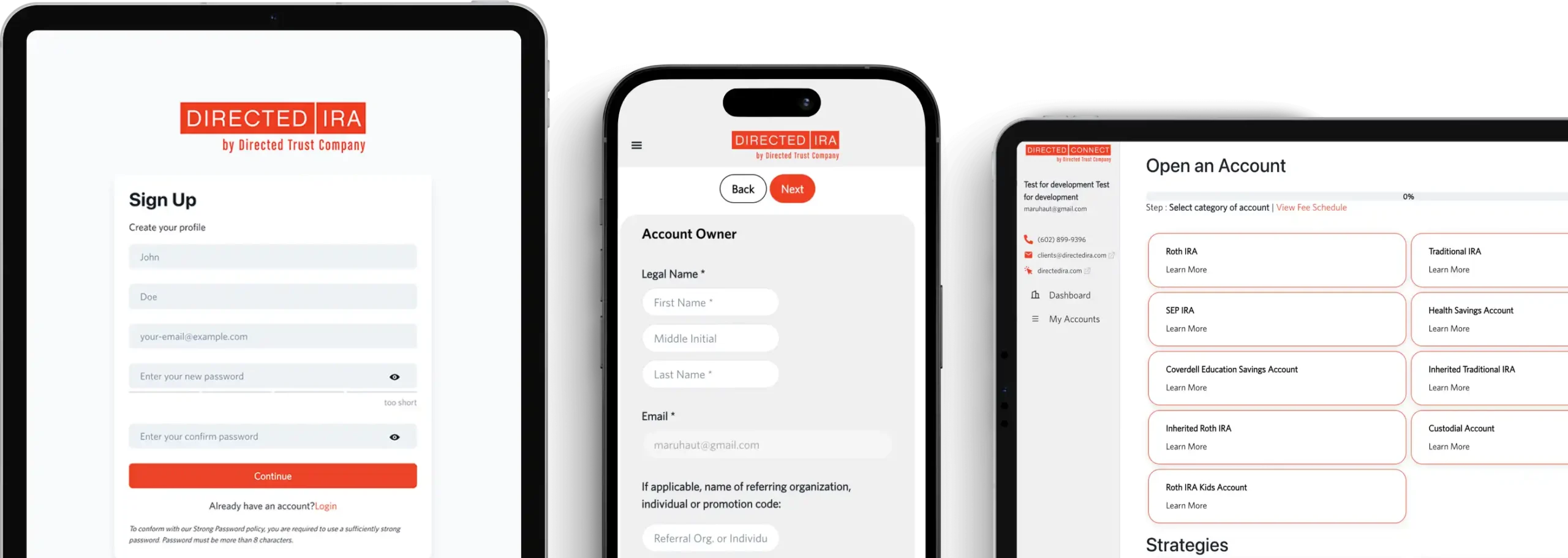
The online application takes as little as 5 minutes. You’ll choose your account type, create a login, then fill out and e-sign the application.
Pick the account that fits your situation. Every one of them can be self-directed, and you can hold more than one.
| If you… | Consider |
|---|---|
| want tax-free growth and qualify to contribute | Roth IRA. Qualified withdrawals are tax-free. It’s Directed IRA’s most popular account. |
| want a tax deduction now, or are moving pre-tax money | Traditional IRA. Contributions may be deductible and growth is tax-deferred. |
| are self-employed with no full-time employees | Solo 401(k). Much higher limits: up to $72,000 for 2026. |
| own a business and want simple employer contributions | SEP IRA. Contribute up to 25% of compensation, up to $72,000 for 2026. |
| inherited an IRA | Inherited IRA. Keep the money tax-advantaged and self-direct it. |
| have a high-deductible health plan | Health Savings Account (HSA). Deductible contributions and tax-free withdrawals for medical costs. |
| want to buy crypto with retirement money | Crypto IRA. Buy and sell crypto inside a Roth or Traditional IRA. |
| earn too much to contribute to a Roth directly | Backdoor Roth IRA. Contribute to a Traditional IRA, then convert it to a Roth. |
| have a child with earned income | Kids Roth IRA. A parent or guardian opens and manages it until the child comes of age. |
| are saving for a child’s education | Coverdell ESA. Tax-free growth for qualified education costs. |
| want checkbook control for frequent investments | Checkbook IRA/LLC. Your IRA owns an LLC you manage, so you can sign checks for IRA investments. |
Not sure which one fits? Book a free 15-minute call and our new account team will help you choose, or compare all account types.
Once your account is open, you can move money in three ways. Most people fund a self-directed IRA with a transfer or rollover from an account they already have.
Open and fund your account before you find an investment, so your money is ready when the right deal comes along. See how transfers and rollovers work.
Directed IRA charges flat fees for accounts under $2 million, so your fees don’t rise as your account grows.
Crypto IRAs cost $295 a year plus 0.50% on each trade. Most clients pay their fees by card to keep more money invested in their IRA. See the complete fee table.
Most banks and brokerages only let your IRA buy what they sell, like stocks, bonds and mutual funds. To invest in alternative assets, you need a self-directed IRA custodian. Here’s what to check, and how Directed IRA measures up.
Directed IRA is a Tradename of Directed Trust Company, an Arizona-licensed trust company examined by the state and audited annually by outside CPA firms.
Founded in 2018 by two tax attorneys. Today Directed IRA holds 25,000+ retirement accounts.
#1 rated for customer service, with 1,300+ 5-star Google reviews.
Free guides, webinars and a podcast, plus an online portal to open, fund and invest.
Flat fees for accounts under $2 million, so your costs don’t grow with your balance.
Directed IRA doesn’t sell investments or give investment advice, so you choose what your IRA buys. How to choose a self-directed IRA custodian walks through each factor, and Are self-directed IRAs safe? covers how your account is protected.
The online application takes as little as 5 minutes. Funding depends on where your money is coming from. Directed IRA requests transfers from other IRAs for you, and a 401(k) rollover moves on your plan’s timeline. Opening and funding your account before you find an investment means your money is ready when you are.
Anyone who can have an IRA can have a self-directed IRA. You can move money from an existing IRA or old 401(k) at any income. To make new contributions, you or your spouse need earned income, and Roth IRA contributions phase out at higher incomes (for 2026, starting at $153,000 for single filers and $242,000 for married couples filing jointly).
No. Most investments are made directly by your IRA, with Directed IRA signing as custodian. Some investors add a Checkbook IRA/LLC later for checkbook control, but an IRA/LLC is a tool, not a requirement.
Yes. You can move only part of an existing IRA or 401(k) and leave the rest where it is. The annual contribution limit is shared across all your Traditional and Roth IRAs.
Only if your plan allows in-service rollovers, which often start at age 59½. A 401(k) from a former employer can usually be rolled over at any time.
The primary difference between Self-Directed IRAs (SDIRAs) and Brokerage IRAs (regular IRAs) is their range of investment options. An SDIRA is any IRA (Roth or Traditional) administered by an IRA custodian who allows the IRA owner to invest in any asset allowed by law. Common investment asset choices for SDIRAs include real estate, notes, private funds (VC, PE), LLCs, and precious metals. You can also invest in crypto with your IRA using our Crypto IRA. The flexibility of an SDIRA lets investors take control of their retirement by investing in alternative assets, while Brokerage IRAs typically restrict an investor’s options to conventional assets like stocks, bonds, and mutual funds.
You can move funds from existing retirement accounts, such as a traditional IRA or 401(k), using one of three methods: Trustee-to-Trustee Transfer, Direct Rollover, or a 60-Day Rollover. A transfer or rollover is the process of moving from a custodian who will not allow you to self direct your IRA to a custodian who will allow you to self direct your IRA. Regardless of the method used, the amounts transferred or rolled over (within 60 days) stay as tax favored retirement account funds and are not distributions subject to any tax or penalty. Learn more.
No, Directed IRA does not sell investments. As an industry-leading SDIRA custodian, Directed IRA provides the account tools and support necessary for investors to self-direct their accounts into investments of their choosing. IRA owners at Directed IRA find, vet, and secure each investment for their self-directed IRA. Directed IRA offers many educational resources covering the complexities of self-directing and can help you every step of the way but does not offer investment, tax, or legal advice and does not provide or endorse any investment option.
Contribution limits for accounts at Directed IRA depend on the type of self-directed account you have (Traditional, Roth, HSA, ESA, etc.) as well as factors like your income and tax filing status. The IRS sets these limits, which can change periodically, so it’s important to stay informed about the latest guidelines. For 2026, the limit for Traditional and Roth IRAs is $7,500, or $8,600 if you’re 50 or older.
Follow these steps to self-direct your account at Directed IRA:
1. Open Your Account: You must have an existing account at Directed IRA before investing. This process takes a few minutes and can be done online. Choose from your preferred account type and book a call if you need help.
2. Fund Your Account: Add funds to your account by making a new contribution, transferring funds from an existing retirement account, or by initiating a rollover. All of these can be done from our funding page.
3. Invest Your Account: Choose your preferred investment, such as real estate, private funds, precious metals, or notes. Ensure your investment complies with IRS regulations. Then, submit all necessary paperwork to Directed IRA, ensuring it’s titled in the name of your IRA. Directed IRA will review, process, and execute the investment on your behalf.
At Directed IRA, we believe in keeping SDIRAs simple and affordable for everyone! Our pricing structure for all account types is straightforward, with no surprises. For accounts under $2 million, your fees won’t increase based on the value of your account. Learn more.


New to self-directed retirement accounts? These resources are designed to help you understand the fundamentals and get started the right way.
Access curated webinars, guides, and educational content covering investment options, account structures, and the rules that govern self-directed IRAs.
Mat Sorensen, Attorney, CEO, and Founder of Directed IRA, wrote the #1 book on self-directed IRAs – selling over 60,000 copies nationwide. The Self Directed IRA Handbook is a comprehensive guide written for both investors and advisors alike. Get access to your SDIRA Handbook resources today!
Mat Sorensen, Attorney, CEO, and Founder of Directed IRA, wrote the #1 book on self-directed IRAs – selling over 60,000 copies nationwide. The Self Directed IRA Handbook is a comprehensive guide written for both investors and advisors alike. Download your free copy today!